The most significant original investor in the brewery was Stephen Lewis, who was described as a “silk merchant from London”. The following article gives an insight the size and nature of his business at the time.
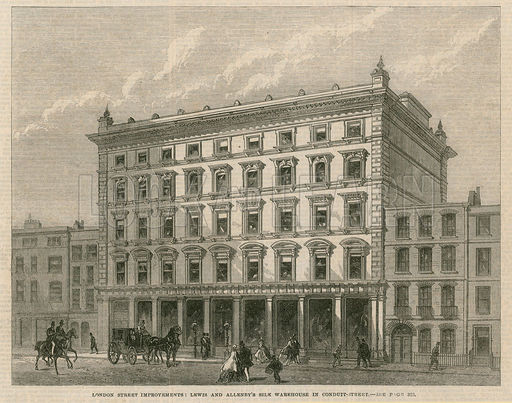
Lewis & Allenby and the Great Exhibition
Of the more than fifteen thousand individual exhibitors at the Great Exhibition held in London in 1851, a sizeable proportion were textile based. Britain was particularly well represented by the nature of its being both the host country for the Exhibition as well as having at the time a particularly healthy textile industry that supplied everything from standard bulk fabrics to luxury goods. One of those that represented the higher end of the domestic textile market was the company of Lewis and Allenby, based in London.
The company were described at the Exhibition as silk merchants and produced a number of textile pieces both woven and printed that were specifically produced for the Exhibition. Many companies like Lewis and Allenby saw the great Exhibition as a golden opportunity to both advertise their particular brand of product, but also as the venue was that of an international affair, foreign orders might even be procured.
Their exhibits were both printed and woven. Amongst the printed examples was that of a complex Paisley design and was meant to follow closely the Indian example of the decorative pattern, rather than the domestic British Paisley. This conscious impression given of a need for accuracy was to imply that the company not only had higher standards of design and production, but that it was also a company that could be trusted to produce a high quality product that went to some pains in order to produce accuracy and finesse within the world of luxury textiles.
Amongst their woven examples was a piece that was designed by the company but actually woven by Harrison, Campbell and Lloyd. It was a particularly large project that involved the weaving of fifteen different colours and required the use of nearly thirty thousand cards and ninety six shuttles. It is unfortunate that no colour examples seem to have ever been produced for this woven silk project. However, that it was expensively produced and of a highly complicated nature was obvious to those who viewed it at the time. It was very much meant to represent an example for the company, but also of the high standards that could be achieved by the British silk weaving industry in general.
Throughout the duration of the Great Exhibition there were a number of nationalistic undercurrents that played themselves out. There was a certain tension between the manufactured goods of Britain and an aspiring Germany despite the fact that at this point in their industrial history Germany was unable to compete fully with Britain. However, the main competitor to Britain was France, particularly in the field of the decorative arts and domestic interiors.
France had for long cornered the luxury textile market in particular and Britain, though wanting to enter fully into this market, felt that although they could out-compete France with cheaper bulk fabrics such as printed cotton, they struggled with the higher and more expensive fabrics. Companies such as Lewis and Allenby were well aware of the French competition and their dominance of the market in luxury fabrics and silks in particular. Therefore the two examples shown here should be seen within the context of Lewis and Allenby and the competition in the form of the long established and highly lauded French silk manufacturers and retailers who were also present in large numbers at the Exhibition.
It must be remembered that the great Exhibition was a venue that encouraged the bespoke and the extravagant, and therefore much of the work tended to be expensively unrepeatable. However, many of the examples shown by more than fifteen thousand companies from all over the planet, did highlight what could conceivably be achieved and the examples produced by Lewis and Allenby were no different in that respect. The public were meant to leave the Exhibition with a positive feeling towards the products displayed and the companies that either produced or sold them. However, how they were to differentiate, or even remember individual themes from such an extraordinary number of manufacturing and retail companies is certainly unknown.
Adapted from Hopper, J 2010, ‘Lewis & Allenby and the Great Exhibition’, The Textile Blog, weblog post, 23 September, accessed 7 May 2013, <http://http://thetextileblog.blogspot.co.uk/2010/09/lewis-allenby-and-great-exhibition.html/>
 A History of The Maltings, Leamington Spa